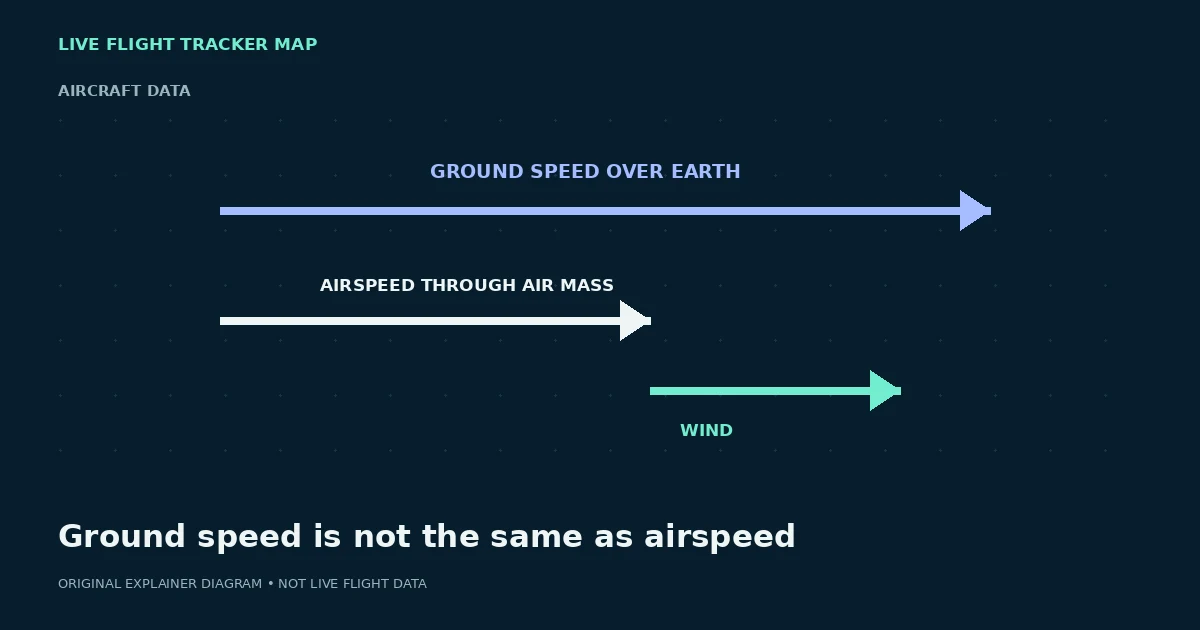
Ground speed describes motion over Earth
Ground speed is how quickly the aircraft is moving across the surface. It is useful for estimating progress along a route and is commonly available in tracking data. A strong tailwind can increase it; a strong headwind can reduce it.
That means a high ground-speed number does not automatically mean the aircraft is flying unusually fast through the surrounding air.
Airspeed describes motion through the air mass
Pilots use several kinds of airspeed for aircraft performance and operations. Those values depend on pressure, density and instrumentation and are not interchangeable with the ground-speed field shown by many public trackers.
At cruise, wind can create a large difference between the speed across the ground and the aircraft’s speed relative to the air around it.
Why the difference is useful
If two flights on similar routes have different ground speeds, winds aloft can be part of the explanation. Direction matters: a tailwind on one leg becomes a headwind in the opposite direction. Route choices and air-traffic constraints also affect the comparison.
Do not infer engine performance or safety from ground speed alone.
Read speed with heading and position age
A speed value belongs to a particular report. Combine it with the update time, heading, altitude and route context. During taxi or after landing, a stale airborne report can be misleading if you ignore its age.
For scheduled arrival estimates, use the airline because its prediction can account for operational information that a public map does not have.
What ADS-B velocity does—and does not—mean
FAA ADS-B guidance describes horizontal and vertical velocity as motion relative to the Earth and explicitly distinguishes those reports from airspeed. That is why a public tracker’s speed field is normally useful for movement over the ground, not as a substitute for the airspeed indications used by a flight crew.
A simple thought experiment helps: an aircraft moving through the air mass at the same performance can cover more ground each hour with a tailwind and less with a headwind. The public ground-speed number changes even though that alone does not tell you the aircraft’s aerodynamic performance.
Further reading
Try a live flight search
Flight status by airline →How this guide is maintained
We review terminology against aviation and airline sources, test examples against the behavior of our own tracker, and separate position data from passenger-status claims. We do not invent a live status when a data source is missing. Corrections can be sent through the contact page.