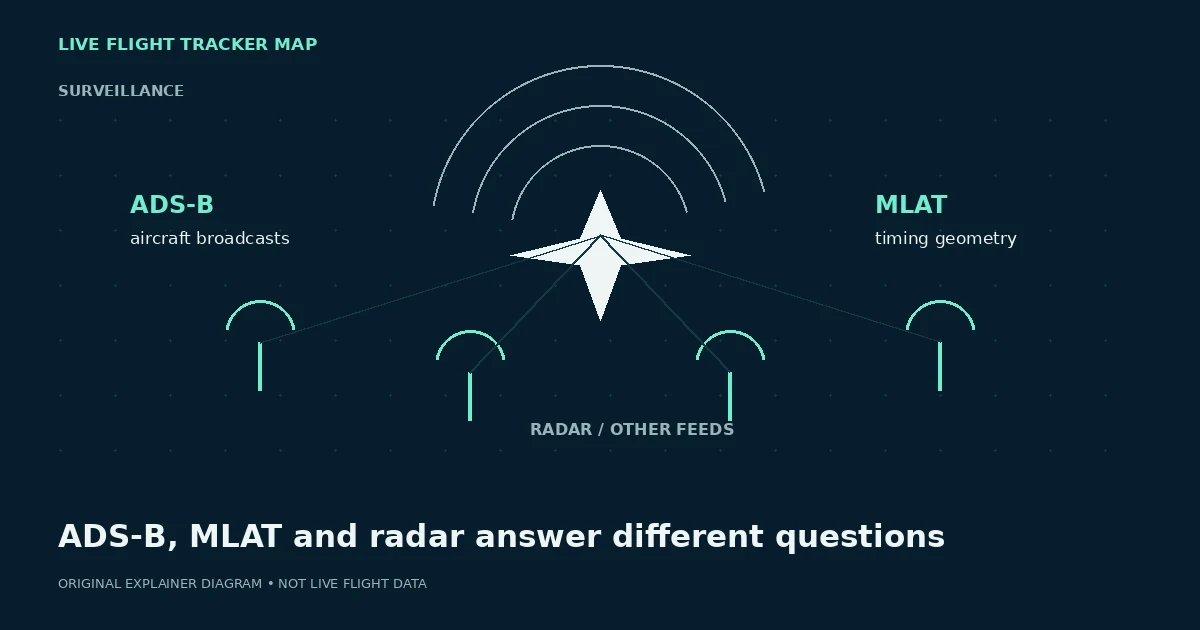
ADS-B is a broadcast from the aircraft
ADS-B equipped aircraft can broadcast identity, position, altitude and motion information that compatible receivers can collect. A flight-tracking service may combine reports from many receivers to build a wider picture. The existence of an ADS-B signal does not mean every website receives it everywhere. Receiver coverage, network availability and filtering all matter.
A displayed point is still a report from a particular moment. Read the update time when one is available instead of assuming a smooth animation means a continuous, exact position.
MLAT estimates position from reception timing
Multilateration can locate certain transponder-equipped aircraft by comparing when the same transmission reaches multiple receivers. Because the calculation needs suitable geometry and several synchronized receiving points, MLAT coverage can be much stronger in one region than another.
That explains why an aircraft can be trackable in a dense receiver area yet disappear when it moves into an area with fewer useful stations.
Radar is not simply another public internet feed
Primary and secondary surveillance radar are parts of air-traffic surveillance infrastructure. Public flight-tracking websites do not all receive the same radar products, and a consumer map should not be treated as an air-traffic-control display. A website can mix several permitted data sources, apply filtering, cache results and render the same underlying information differently.
For that reason, two trackers can disagree slightly without either screen proving what an air traffic controller currently sees.
Why coverage gaps are normal
Low altitude can reduce line-of-sight reception. Remote terrain, oceans and sparse receiver networks can also reduce terrestrial coverage. Some aircraft can be restricted or filtered, and technical outages can interrupt a feed. A missing marker is therefore not a diagnosis of what happened to a flight.
If the journey matters to you, use the airline or airport for passenger status and treat the map as a separate source of position context.
ADS-B Out and ADS-B In are not the same thing
The FAA distinguishes ADS-B Out, where an aircraft broadcasts information including position, altitude and ground speed, from ADS-B In, where equipped aircraft receive traffic or information services. A public flight-tracking website is another consumer of permitted surveillance data; it should not be described as the aircraft’s own cockpit display.
This distinction helps when reading marketing claims. “Uses ADS-B” does not tell you which receiver network, how much coverage is available, whether MLAT or other feeds are combined, how old the last report is, or what filtering a website applies. Those implementation details affect what a visitor ultimately sees.
Further reading
Try a live flight search
Flight status by airline →How this guide is maintained
We review terminology against aviation and airline sources, test examples against the behavior of our own tracker, and separate position data from passenger-status claims. We do not invent a live status when a data source is missing. Corrections can be sent through the contact page.